
October is not the deadline. It is the starting line
4 min read

I should say at the outset that I have a stake in this. I run a software company that works in hazardous waste segregation and tracking, so you can discount my view accordingly. But the reason I built the company is the same reason I am writing this, and it predates the business by about fifteen years.
As a student of applied chemistry, I watched an incident happen that should not have happened. Two things went into a container that should never have shared one. Nobody involved was careless, and nobody was untrained. The information needed to prevent it existed somewhere in the building. It simply was not in the hands of the person holding the bottle at the moment they needed it.
That gap between what an organisation knows and what the person at the bench knows has been an operational and safety problem for decades. From October it becomes a regulatory one, and not just here.
What is actually changing
Defra has laid the secondary legislation. From October 2026, permitted waste receiving sites in England, Wales and Northern Ireland must record every consignment they accept on the Digital Waste Tracking Service. Scotland follows in January 2027. Phase 1 covers roughly 12,000 sites. The public beta has been open since late April, and operators and software providers have been encouraged to use it to shake the system out before the mandate bites.
Phase 2 has moved to October 2027 and brings in carriers, brokers, dealers and exporters, a population of around 300,000, most of them small businesses. Registered exemption holders, another 150,000 or so, follow later. Beta testing for Phase 2 opens this autumn.
Two details that get overlooked. First, there is a charge: £26 per legal entity for twelve months of access once use becomes mandatory, and software providers cannot pay it on a customer's behalf. Second, and more significantly, existing obligations do not switch off. Waste transfer notes, hazardous waste consignment notes, quarterly returns and consignee returns all continue in parallel. For a period, sites will be doing both. Anyone planning on October as the moment the paperwork burden drops is going to be disappointed.
This is not a British story
It is tempting to read DWT as a domestic compliance headache. It is not. It is the UK's instance of something happening across every major regulated economy at roughly the same time.
In the European Union, the Waste Shipment Regulation is pushing notification and consent for cross-border movements onto a central electronic system, replacing a paper process that has been creaking for years. In the United States, the EPA has proposed a rule that would retire paper hazardous waste manifests in favour of the federal e-Manifest system, with a transition period running from any final rule. It is worth being precise here, because a lot of vendor marketing is not: the American rule is proposed, not settled. But the direction is not seriously in doubt, and the practical position for a US generator is uncomfortable either way. Electronic adoption of e-Manifest has been very low since the system launched, which means the gap between where facilities are and where they will need to be is wide.
Put the three together and a pattern emerges. Regulators everywhere have concluded the same thing: you cannot govern what you cannot see, and paper does not let you see anything until long after it matters. What is arriving is not a new form. It is the end of the delay between an event happening and a regulator being able to know about it.
Why this is genuinely good, and not just more admin
I want to make the environmental case properly, because it is stronger than the compliance case and it gets made badly.
Waste crime costs the UK economy around £1 billion a year. It is enabled by weak record keeping, falsified paperwork and inconsistent process. A real-time digital audit trail makes fabrication considerably harder and makes the honest operator's compliance visible in a way that a folder of consignment notes never did. That alone justifies the exercise.
But the bigger environmental prize sits upstream, in classification and segregation. What happens to a waste stream is determined almost entirely by what is in it and how confident anyone is about that. A correctly characterised, uncontaminated stream can often be recovered, reprocessed or treated at a lower tier. The same material, once a single incompatible item goes into the container, is downgraded. It becomes a mixed unknown, and mixed unknowns go to high temperature incineration because that is the only defensible route left. Every one of those events is a small, invisible sustainability loss that nobody reports because nobody logs it.
Digital tracking creates, for the first time, a data set that makes those losses visible. It also makes ESG and Scope 3 waste reporting something other than an estimate built on a vendor's invoice. If your sustainability report currently relies on tonnages inferred from what you were billed for, you are not measuring your waste. You are measuring your procurement of waste services.
The part nobody wants to say out loud
Phase 1 places the legal obligation on receiving sites. But receiving sites do not create the data. They inherit it.
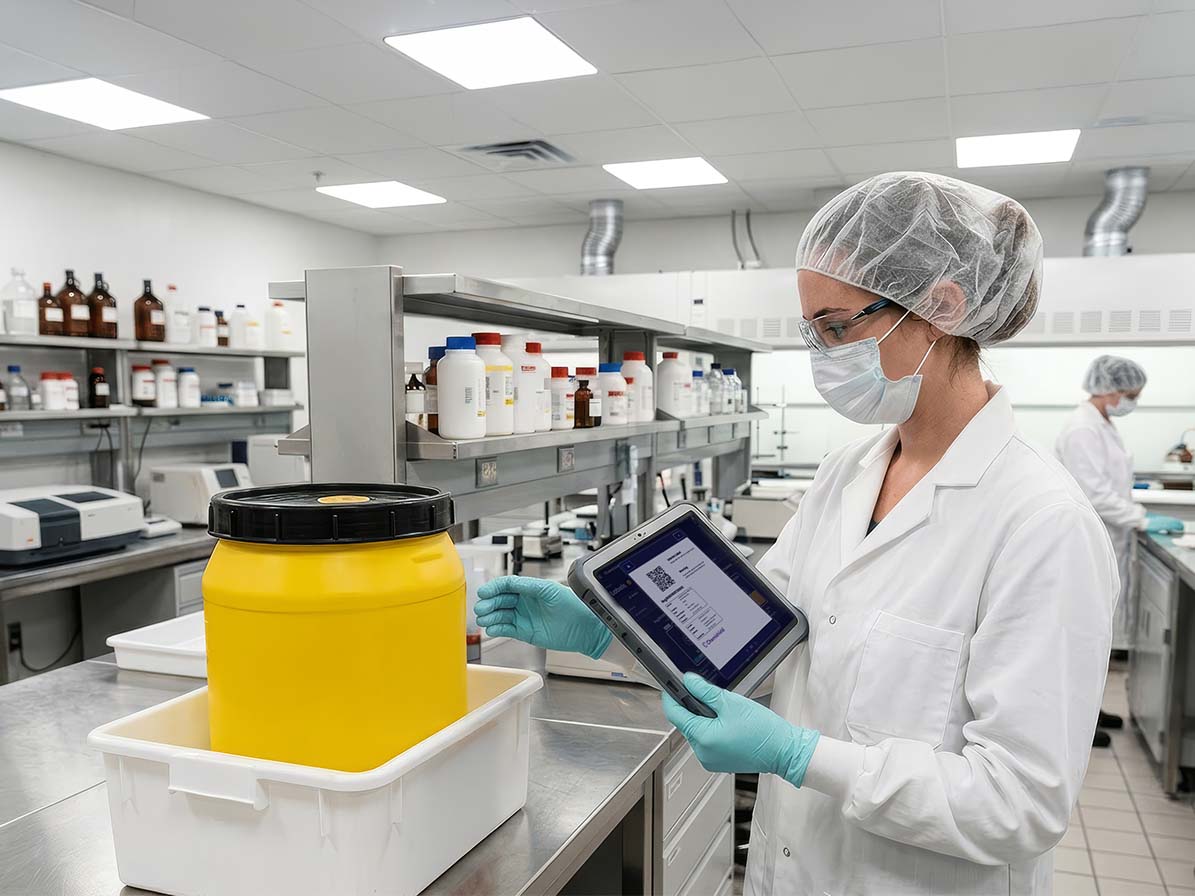
The classification, the description, the EWC code and the contents of the container all originate upstream, at the point of generation, usually with someone in a laboratory or on a production line who has thirty seconds and a bottle in their hand. The receiving site is accountable for the accuracy of a record it did not author. Producers, who are not in Phase 1 at all, are the ones actually determining whether the national data set is any good.
This is why I do not think October is a deadline. A deadline implies you cross it and you are done. What happens in October is that every weakness in upstream data capture stops being a private inconvenience and becomes a visible, dated, attributable record in a national system. Digitising a bad process produces a very well documented bad process.
What being ready actually looks like
If I were sitting on the operator side, this is the sequence I would work through.
Know exactly which phase you are in and when. A surprising number of businesses are confident they are out of scope and are wrong, usually because they hold a carrier licence they have forgotten about.
Get into the beta now rather than in September. The value is not in early compliance, it is in finding out what your data looks like when a structured system refuses to accept it.
Audit your waste descriptions and classification codes before anyone else does. This is the single highest-value thing available to you this year and it costs nothing but attention.
Plan and resource the double-running period honestly. Paper and digital together, for months.
Talk to the parties either side of you. Producers should be asking their receiving sites what they will need from October. Receiving sites should be telling their producers now, not in the week the mandate lands.
And treat the output as data rather than paperwork. The organisations that will get the most out of this are the ones that stop asking how to satisfy the regulator and start asking what a complete, accurate record of every material leaving their site is worth to them.
That last question is the one I find interesting, and it takes me back to the student in the lab. A digital record has value as evidence after the fact. It has far more value as a control before the fact, at the moment someone is deciding where something goes. The regulation is going to force the record. Whether you also get the prevention depends entirely on where in your process you decide to capture it.
October is not the finish. It is the point at which the industry finally starts keeping score







.avif)